
40 lines
3.7 KiB
Markdown
40 lines
3.7 KiB
Markdown
# What is the Byzantine Generals Problem in Distributed Systems?
|
||
|
||
- **期号**: SRE Weekly Issue #463(2025-02-09)
|
||
- **作者**: Sid — The Scalable Thread
|
||
- **链接**: https://newsletter.scalablethread.com/p/what-is-the-byzantine-generals-problem
|
||
|
||
## 简介
|
||
|
||
This is the clearest and most concise explanation of the Byzantine Generals Problem that I’ve read.
|
||
|
||
## 正文
|
||
|
||
The Byzantine Generals Problem is a thought experiment in distributed computing to understand the challenges of reaching a consensus when some nodes may be untrustworthy or unreliable (node behavior). It shows how difficult it can be to coordinate actions when some system members may act dishonestly.
|
||
|
||
## The Byzantine Generals Problem
|
||
|
||
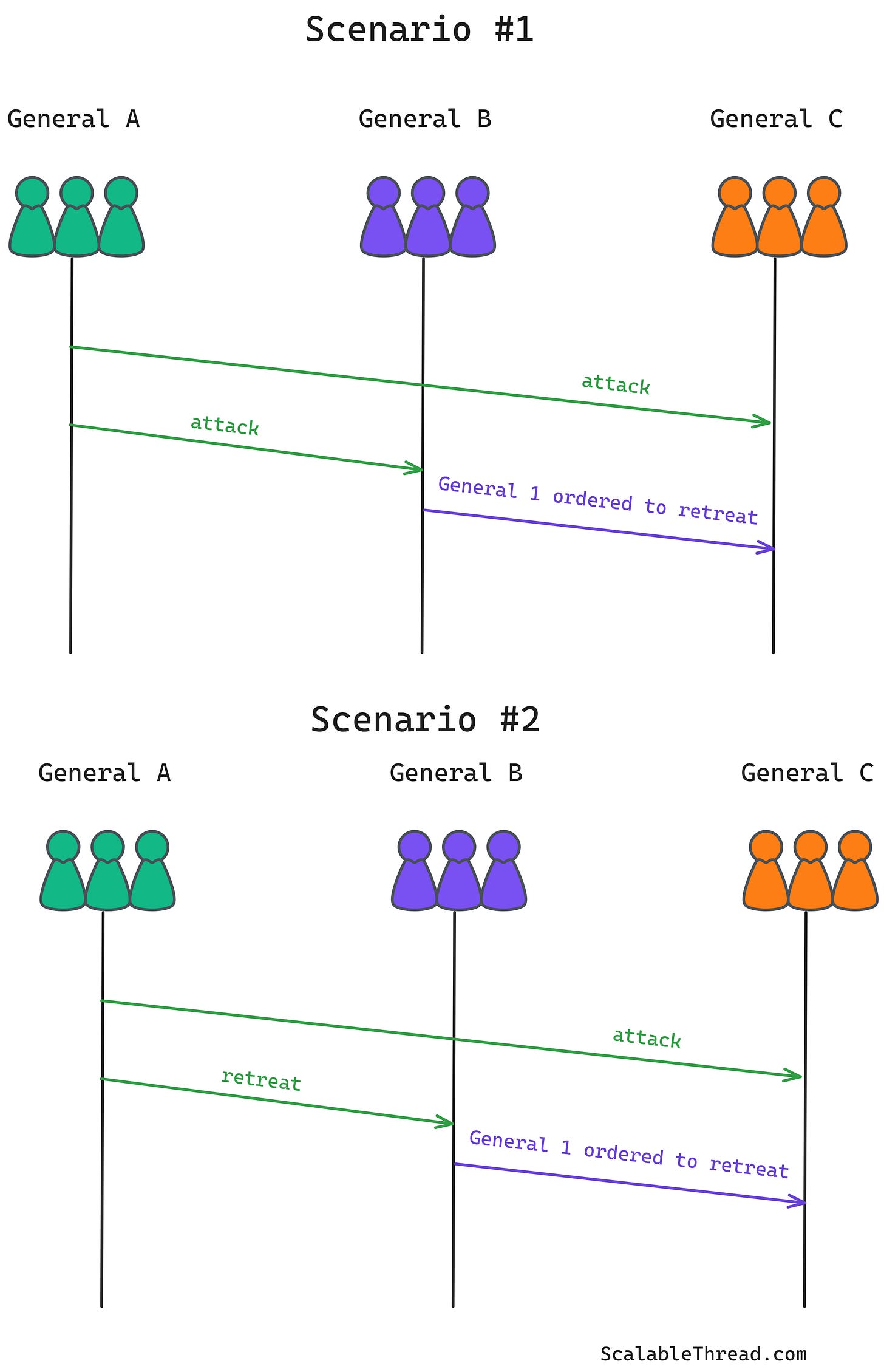
Imagine three or more generals surrounding a city they want to capture. They need to agree on one action: attack or retreat. They can only communicate through messengers. Unlike [the two generals problem](https://newsletter.scalablethread.com/p/what-is-the-two-generals-problem), the messages will be delivered correctly this time. However, one or more generals could be "traitors" who send false or confusing messages. The honest generals cannot ignore a suspected traitor's message because they don't know who the traitors are. The goal is for all honest generals to agree on the same plan: attack or retreat. For example, if General C receives two contradicting messages—one from General A saying to attack and another from General B saying General A ordered a retreat—General C cannot tell if General B is lying or if General A is giving false information.
|
||
|
||
|
||
|
||
## Node Behavior in Distributed Systems
|
||
|
||
In distributed systems, Generals represent the nodes or processes involved. Messages are the communications that happen between these nodes. Traitors are faulty or malicious nodes, known as *Byzantine nodes*, that may send incorrect or false information. Consensus is the agreement that all working nodes must reach a single value or action (an agreement).
|
||
|
||
A Byzantine node can behave in unpredictable ways. It might send different messages to different nodes, fake messages, or fail to send messages altogether. This is similar to a general who spreads lies and tries to mess up communication. For example, in a blockchain network, nodes must agree on the order of transactions. A malicious node might try to spread false transactions or mess with the consensus process, risking the integrity of the blockchain.
|
||
|
||
## 3f + 1 Rule
|
||
|
||
The Byzantine Generals Problem has an important limitation: it is impossible to reach an agreement if more than one-third of the participants are faulty. This is the "3f+1" rule, where 'f' is the number of faulty nodes. In simpler terms, if there are 'f' faulty nodes, there must be at least 2f + 1 loyal nodes. This way, even if the faulty nodes team up to share wrong information, the loyal nodes will still have a majority and can reach an agreement.
|
||
|
||
For example, if we expect at most one faulty node (f=1), we need at least four nodes (3*1 + 1 = 4) in the system. With four nodes, even if one is faulty, the remaining three loyal nodes can vote against the faulty one and reach a consensus.
|
||
|
||
## References
|
||
|
||
- Martin Kleppmann. (2020, October 28). *Distributed Systems 2.2: The Byzantine generals problem* [Video]. YouTube.[https://www.youtube.com/watch?v=LoGx_ldRBU0](https://www.youtube.com/watch?v=LoGx_ldRBU0)
|
||
|
||
*If you enjoyed this article, please hit the ❤️ like button.*
|
||
|
||
*If you think someone else will benefit from this, then please 🔁 share this post.*
|