
56 lines
3.0 KiB
Markdown
56 lines
3.0 KiB
Markdown
# More telemetry makes reliability worse (until you fix the loop)
|
||
|
||
- **期号**: SRE Weekly Issue #506(2026-01-18)
|
||
- **作者**: Ash Patel
|
||
- **链接**: https://read.srepath.com/p/more-telemetry-makes-reliability
|
||
|
||
## 简介
|
||
|
||
Poor telemetry makes us want to add more telemetry, which can decrease our telemetry quality and make us add more, yikes! How can we fix the feedback loop?
|
||
|
||
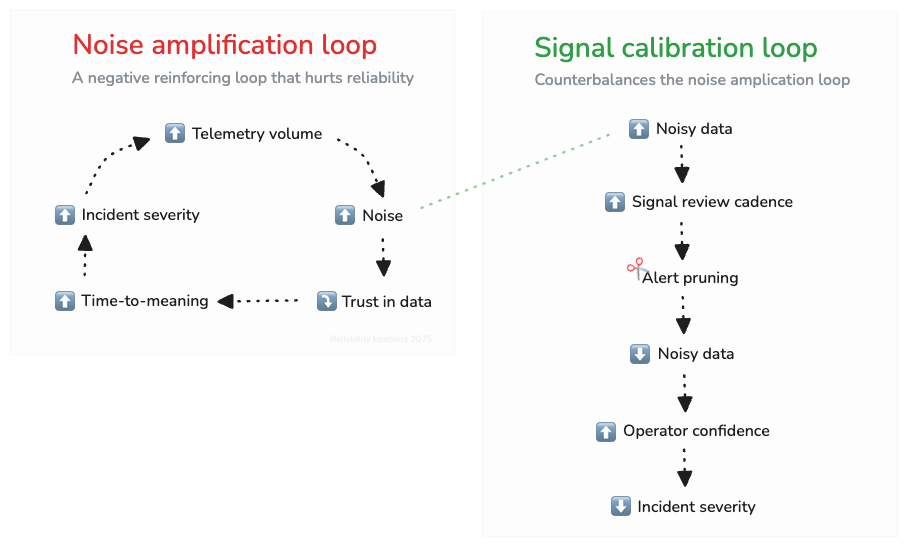
Note for blind or low-vision readers: there’s a pretty important diagram in this one without a caption or alt text.
|
||
|
||
## 正文
|
||
|
||
Every reliability engineer eventually learns the same painful truth: you can have a thousand dashboards showing you *xyz* and still miss the real signal.
|
||
|
||
This might feel like an insurmountable hurdle at first glance.
|
||
|
||
One of those “it is what it is” situations. After all:
|
||
|
||
The more data we collect → the more noise we face → the less trust we have in our alerts → the slower we respond → the more incidents worsen → the more data we collect to compensate.
|
||
|
||
|
||
|
||
In MIT’s world of System Dynamics, this noise amplification problem is what we’d call a *reinforcing loop*.
|
||
|
||
It’s a spiralling up of information overload as the loop continues to reinforce, or metaphorically snowball, onto itself. But here’s the thing…
|
||
|
||
Observability (o11y) isn’t just telemetry.
|
||
|
||
It’s also who interprets, triages, and learns from the telemetry: a *balancing loop*.
|
||
|
||
In a healthy system, every new signal that enters should trigger an equal and opposite stabilizing action, essentially a check-and-balance. That’s the balancing loop at work.
|
||
|
||
For example, when noise increases, teams should automatically slow alert creation or tighten signal thresholds to wait until trust recovers.
|
||
|
||
When signal quality improves, they can loosen up again.
|
||
|
||
Without that feedback control, the system loses balance, and the painful reinforcing loop that I mentioned earlier takes over.
|
||
|
||
If your team doesn’t trust the data, or worse, doesn’t have time to translate it, your observability system isn’t truly “seeing everything”.
|
||
|
||
That’s why engineers with Staff+ potential treat incident retros and observability reviews like a process tuning. They ask:
|
||
|
||
- Who sees which o11y signals, and when?
|
||
- What incentives drive our attention to o11y signals?
|
||
- Where does learning from outputs feed back into o11y design?
|
||
|
||
Small interventions like taking the time to prune unhelpful alerts can have an outsized impact in the long run because they restore the balancing loop between data and actionability.
|
||
|
||
This should be your takeaway: reliability improves when observability helps people modify their impact from using the system, not just seeing the outputs of their services.
|
||
|
||
So observability goal is a behaviour change that leads to a better reliability.
|
||
|
||
Truer words rarely spoken
|