
105 lines
8.5 KiB
Markdown
105 lines
8.5 KiB
Markdown
# SLO
|
||
|
||
- **期号**: SRE Weekly Issue #424(2024-05-12)
|
||
- **作者**: Alex Ewerlöf
|
||
- **链接**: https://blog.alexewerlof.com/p/slo
|
||
|
||
## 简介
|
||
|
||
An intro to SLOs with useful formulas, from the creator of the SLO Calculator featured here awhile back.
|
||
|
||
## 正文
|
||
|
||
Service Level Objective (SLO) sets the reliability expectation for the service based on how the service consumer perceives reliability ([SLI](https://blog.alexewerlof.com/p/sli)).
|
||
|
||
One of the key ideas behind SLO is to shift the expectations from 100% reliability (which is not practical, and leads to disappointment, finger-pointing, and unreasonably high cost) to a number that is reasonable (e.g. 99%).
|
||
|
||
The difference is small (e.g. 1%) but it clarifies the error budget as a way to transparently balance the cost of reliability while controlling the risks of changing a system and setting the pace of those changes. The “pace” aspect comes in handy when doing [Pace Layering](https://blog.alexewerlof.com/p/wardley-maps-and-pace-layering-for), for example the critical services have a stricter reliability goal than the more experimental ones.
|
||
|
||
SLOs are internal **goals** that help teams make data-driven decisions about reliability and prioritize engineering work, such as balancing the speed of feature delivery with the need for stability
|
||
|
||

|
||
|
||
There are three aspects that defining a SLO:
|
||
|
||
1. **The value:** usually a number like`99.9%`
|
||
2. **[The compliance period](https://blog.alexewerlof.com/p/compliance-period) (also known as “window”):** usually`30` days. This is the time window which is used to count events or time-slices in the past to calculate the SLS ([Service Level Status](https://blog.alexewerlof.com/p/sls) ).
|
||
3. **[The boundaries](https://blog.alexewerlof.com/p/sli-good) (optional):** for SLIs that use thresholds for what good events look like (e.g., if a latency below`800ms` is considered good, the number 800ms is part of the threshold).
|
||
|
||
*Note: all three are used for [multi-tiered SLOs](https://blog.alexewerlof.com/p/multi-tiered-slos) which tie to the same SLI.*
|
||
|
||
SLO heavily impacts the non-functional requirements ([NFR](https://blog.alexewerlof.com/p/nfr)) for how the technical solution is designed, built, operated, secured, maintained, and budgeted.
|
||
|
||
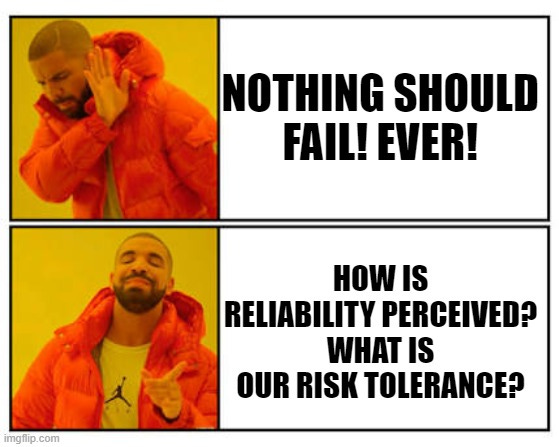
While SLO gets all the publicity, the [error budget](https://blog.alexewerlof.com/p/error-budget) is the real hero of reliability engineering. If you remember from [why bother with service levels](https://blog.alexewerlof.com/p/why-bother-with-sli-and-slo), we are trying to shift the mindset from “systems should never fail” to understanding what failure is (SLI) and how much of it can be tolerated (error budget).
|
||
|
||
|
||
|
||
Error budget is the maximum percentage of failure that the service is allowed to have in a given period. It is directly tied to the SLO. In fact, it complements the SLO:
|
||
|
||
For example, if the SLO is `99%`, the *error budget* is `1%`. If SLO is `99.6%`, the *error budget* is `0.4%`.
|
||
|
||
## Example
|
||
|
||
Let’s start simple by defining an SLO for an API (service) which is consumed by two teams: a mobile team and a web team (service consumers).
|
||
|
||
The mobile app and web are the interface towards users. The business makes money by charging the users a monthly fee (e.g., something like Netflix).
|
||
|
||
*Note: since money is involved, there may be an [SLA](https://blog.alexewerlof.com/p/sla) too, but it’s out of the scope of this article.*
|
||
|
||

|
||
|
||
The mobile and web team want to hold the team behind the API (service provider) accountable for keeping the API available.
|
||
|
||
The service consumers in this example perceive the reliability of the API based on its uptime (i.e., a [time-based SLI](https://blog.alexewerlof.com/p/time-based-vs-event-based)).
|
||
|
||
Together with the API team they agree to use a probe to check the API availability every minute
|
||
|
||
*Note: there are many ways to measure availability. Pinging an end point every minute doesn’t give the best signal but it’s easy to start with.*
|
||
|
||
They decided on an SLO window of `30 days` because the subscribers are charged on a monthly basis and the UX study has some data about how much failure the customers can put up with before they seriously consider cancelling their subscription.
|
||
|
||
The maximum downtime the web team can tolerate is `10 minutes` per month.
|
||
|
||
But the mobile app team can tolerate a maximum of `2 hours` downtime per month due to on-device caching in their implementation.
|
||
|
||
Here’s what we know:
|
||
|
||
- **Service** = API
|
||
- **Service Provider** = the team behind the API
|
||
- **Service Consumers** = mobile app and web team
|
||
- **[Service Level Indicator](https://blog.alexewerlof.com/p/sli)** = Availability. Ping the`/health` endpoint every minute ([time-based](https://blog.alexewerlof.com/p/time-based-vs-event-based) )
|
||
- **[Compliance Period](https://blog.alexewerlof.com/p/compliance-period)** [(SLO window)](https://blog.alexewerlof.com/p/compliance-period) =`30 days` =`43800 minutes` (you can[use Google](https://www.google.com/search?q=month+to+minutes) for these conversions)
|
||
- Rolling window: at any given time, we look at the past `43800 minutes` .
|
||
- **[Error budget](https://blog.alexewerlof.com/p/error-budget)** =`min(10m, 120m)` (the SLO needs to satisfy the requirement of the most demanding consumer.
|
||
|
||
The API team checks the historical data for their availability metrics. We call that a [Service Level Status](https://blog.alexewerlof.com/p/sls) (SLS) to distinguish it from the SLI which is a metric and SLO which is an objective.
|
||
|
||
The API team checked their historical uptime and learned that in the past `90 days (129600 minutes)`, they had a downtime of `85 minutes`. That’s what they’re comfortable to commit to (the status-quo):
|
||
|
||
This is below the level that the web team can tolerate (10 minutes downtime in 30 days):
|
||
|
||
But it is above the level that the mobile team can tolerate (120 minutes downtime in 30 days):
|
||
|
||
So, we have `99.93%`, `99.97%`, and `9.72%`. Which one should we pick?
|
||
|
||

|
||
|
||
Of course, the API team prefers the smallest SLO (`99.72%`) because that gives them a higher error budget.
|
||
|
||
But that SLO is below the level that the web team needs with its current implementation. What can they do?
|
||
|
||
As we discussed in the [”lagom” SLO](https://blog.alexewerlof.com/p/lagom-slo), the web team has three options:
|
||
|
||
1. **Be prepared for outage**
|
||
2. **Share the risk with their consumers (end users)**
|
||
3. **Negotiate with the API team**
|
||
|
||
The negotiation is tricky because the service provider and service consumer have a conflict of interest.
|
||
|
||
- The provider wants to maximize the error budget and may use [the rule of 10x/9](https://blog.alexewerlof.com/p/10x9) to their defense.
|
||
- The consumer wants to maximize the SLO and uses the paying customer experience as an argument
|
||
|
||
Finding *impactful* SLI and *reasonable* SLO can be very tricky. As a Sr Staff Engineer responsible for a large organization (100+ teams), I have covered more than half of those teams with Service Level Workshops. I’ll be sharing the steps and experience [in an upcoming post](https://blog.alexewerlof.com/p/service-level-workshops).
|
||
|
||
[My monetization strategy](https://blog.alexewerlof.com/p/faq#%C2%A7payment) is to give away most content for free. However, these posts take anywhere from a few hours to days to draft, edit, research, illustrate, and publish. I pull these hours from my private time, vacation days and weekends. Recently I went down in working hours and salary by 10% to be able to spend more time on the newsletter. You can support me by sparing a few bucks for a paid subscription. As a token of appreciation, you get access to the Pro-Tips section as well as my book [Reliability Engineering Mindset](https://blog.alexewerlof.com/p/book-intro-reliability-engineering). Right now, you can get 20% off via [this link](https://blog.alexewerlof.com/protipsdiscount).
|