
116 lines
4.9 KiB
Markdown
116 lines
4.9 KiB
Markdown
# A debugging manifesto
|
||
|
||
- **期号**: SRE Weekly Issue #351(2022-12-11)
|
||
- **作者**: Julia Evans
|
||
- **链接**: https://jvns.ca/blog/2022/12/08/a-debugging-manifesto/
|
||
|
||
## 简介
|
||
|
||
Tons of incredibly good advice in this infographic + article on debugging.
|
||
|
||
## 正文
|
||
|
||
# A debugging manifesto
|
||
|
||
Hello! I’ve been working on a zine about debugging for the last 6 months with
|
||
my friend [Marie](https://marieflanagan.com/), and one of the problems we ran
|
||
into was figuring out how to explain the right *attitude* to take when debugging.
|
||
|
||
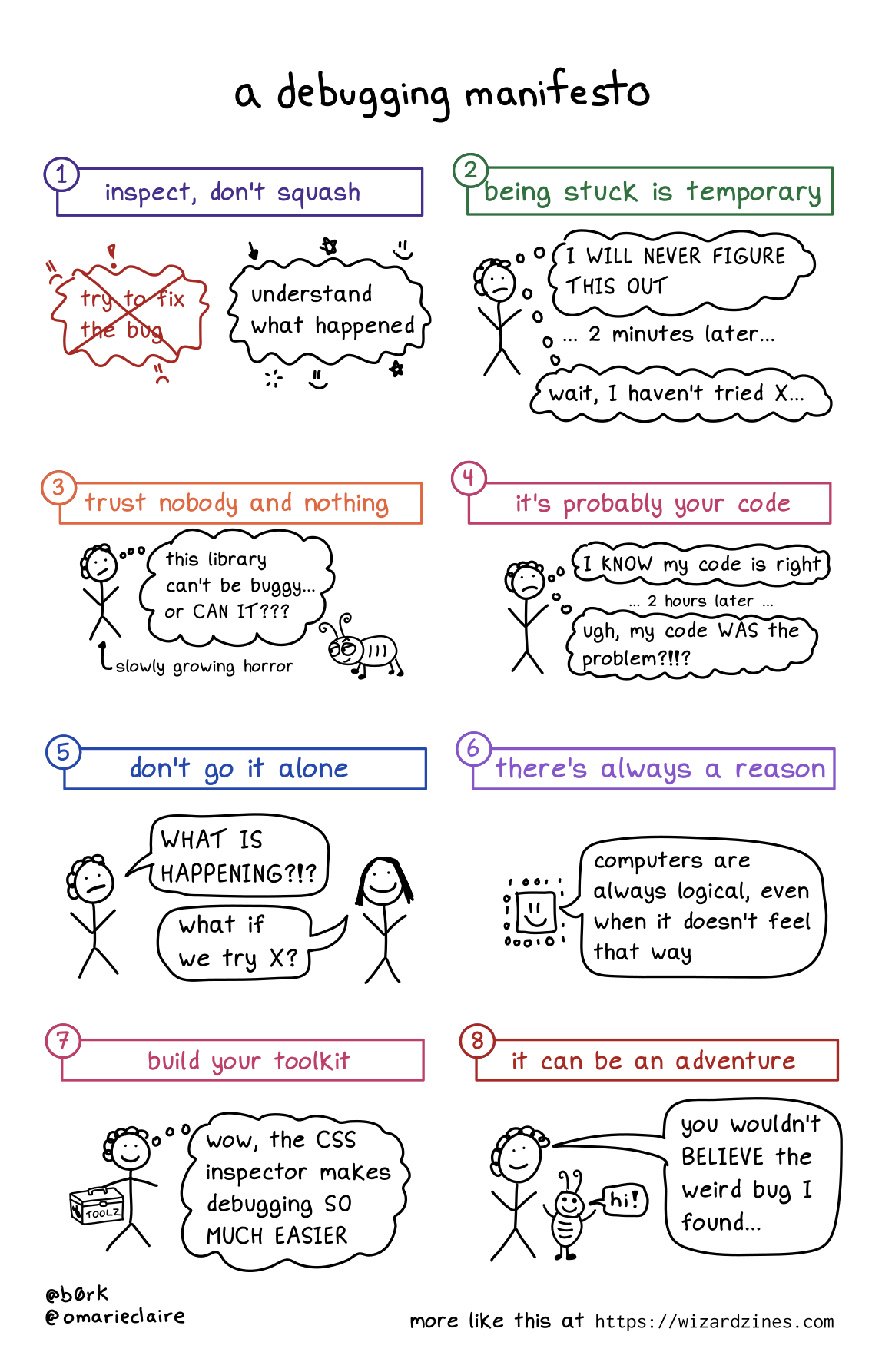
We ended up writing a short debugging manifesto to start the zine with, and I’m pretty happy with how it came out. Here it is as an image, and as text (with some extra explanations)
|
||
|
||
|
||
|
||
###
|
||
|
||
[1. Inspect, don’t squash](https://jvns.ca#1-inspect-don-t-squash)
|
||
|
||
|
||
When you run into a bug, the natural instinct is to try to *fix it* as fast as
|
||
possible. And of course, sometimes that’s what you have to do – if the bug is
|
||
causing a huge production incident, you have to mitigate it quickly before
|
||
diving into figuring out the root cause.
|
||
|
||
But in my day to day debugging, I find that it’s generally more effective (and
|
||
faster!) to **leave the bug in place**, figure out exactly what’s gone wrong,
|
||
and then fix it after I’ve understood what happened.
|
||
|
||
Trying to fix it or add workarounds without fully understanding what happened
|
||
usually ends up just leaving me *more* confused.
|
||
|
||
###
|
||
|
||
[2. Being stuck is temporary](https://jvns.ca#2-being-stuck-is-temporary)
|
||
|
||
|
||
Sometimes I get really demoralized when debugging and it feels like I’ll NEVER make progress.
|
||
|
||
I have to remind myself that I’ve fixed a lot of bugs before, and I’ll probably fix this one too :)
|
||
|
||
###
|
||
|
||
[3. Trust nobody and nothing](https://jvns.ca#3-trust-nobody-and-nothing)
|
||
|
||
|
||
Sometimes bugs come from surprising sources! For example, in [I think I found a Mac kernel bug?](https://jvns.ca/blog/2018/01/28/mac-freeze/) I describe how,
|
||
the first time I tried to write a program for Mac OS, I had a bug in my program
|
||
that was caused by a Mac OS kernel bug.
|
||
|
||
This was really surprising (usually the operating system is not at fault!!), but sometimes even normally-trustworthy sources are wrong. Even it’s a popular library, your operating system, the official documentation, or an extremely smart and competent coworker!
|
||
|
||
###
|
||
|
||
[4. It’s probably your code](https://jvns.ca#4-it-s-probably-your-code)
|
||
|
||
|
||
That said, **almost all of the time** the problem is not “there’s a bug in Mac
|
||
OS”. I can only speak for myself, but 95% of the time something is going wrong
|
||
with my program, it’s because I did something silly.
|
||
|
||
So it’s important to look for the problem in your own code first before trying to blame some external source.
|
||
|
||
###
|
||
|
||
[5. Don’t go it alone](https://jvns.ca#5-don-t-go-it-alone)
|
||
|
||
|
||
I’ve learned SO much by asking coworkers or friends for help with debugging. I think it’s one of the most fun ways to collaborate because you have a specific goal, and there are tons of opportunities to share information like:
|
||
|
||
- how to use a specific debugging tool (“here’s how to use GDB to inspect the memory here….”)
|
||
- how a computer thing works (“hey, can you explain CORS?”)
|
||
- similar past bugs (“I’ve seen this break in X way in the past, maybe it’s that?”)
|
||
|
||
###
|
||
|
||
[6. There’s always a reason](https://jvns.ca#6-there-s-always-a-reason)
|
||
|
||
|
||
This one kind of speaks for itself: sometimes it *feels* like things are just
|
||
randomly breaking for no reason, but that’s never true.
|
||
|
||
Even if something truly weird is happening (like a hardware problem), that’s still a reason.
|
||
|
||
###
|
||
|
||
[7. Build your toolkit](https://jvns.ca#7-build-your-toolkit)
|
||
|
||
|
||
I’ve written a LOT about my love for debugging tools like tcpdump, strace, and more on this blog.
|
||
|
||
To fix bugs you need information about what your program is doing, and to get that information sometimes you need to learn a new tool.
|
||
|
||
Also, sometimes you need to build your own better tools, like by improving your test suite, pretty printing, etc.
|
||
|
||
###
|
||
|
||
[8. It can be an adventure](https://jvns.ca#8-it-can-be-an-adventure)
|
||
|
||
|
||
As you probably know if you’re a regular reader of this blog, I love debugging and I’ve learned a lot from doing it. You get to learn something new! Sometimes you get a great war story to tell! What could be more fun?
|
||
|
||
I really think of debugging as an investment in my future knowledge – if something is breaking, it’s often because there’s something wrong in my mental model, and that’s an opportunity to learn and make sure that I know it for next time.
|
||
|
||
Of course, not *all* bugs are adventures (that off-by-one error I was debugging
|
||
today certainly did not feel like a fun adventure). But I think it’s important
|
||
to (as much as you can) reflect on your bugs and see what you can learn from
|
||
them.
|