
76 lines
4.0 KiB
Markdown
76 lines
4.0 KiB
Markdown
# How SREs are unique in their approach to work
|
||
|
||
- **期号**: SRE Weekly Issue #289(2021-09-26)
|
||
- **作者**: Ash P — Cruform
|
||
- **链接**: https://www.srepath.com/sre-unique-approach-to-work/
|
||
|
||
## 简介
|
||
|
||
> Here are some things that make SREs a unique breed in software work:
|
||
|
||
The one about Scrum caught my eye, and I followed the links through to the Stack Overflow post about SRE and Scrum.
|
||
|
||
## 正文
|
||
|
||
Site Reliability Engineers (SREs) are a rare bunch in the software community. But there’s little denying that the approach of Site Reliability Engineering is the future of software operations.
|
||
|
||
Here are some things that make SREs a unique breed in software work:
|
||
|
||
## SREs look at the broader picture
|
||
|
||
Ask any developer what they’re working on and you’ll see a tiny sliver of the whole codebase. That makes sense for the kind of work that is coding.
|
||
|
||
**Systems, on the other hand, need a holistic view** in order to make sure the whole unit works harmoniously.
|
||
|
||
## SREs thrive in ambiguity
|
||
|
||
Because they have a scope spanning the entirety of a software system, SREs can end up working on various types of problems. Some problems may be well-defined like spooling up infrastructure based on known demand.
|
||
|
||
Other problems may be more abstract like working out how to cost-effectively autoscale a service that has inconsistent usage patterns and needs high performance.
|
||
|
||
## SREs work beyond constraints like Scrum
|
||
|
||
Most developers work within some kind of agile framework like Scrum or XP.
|
||
|
||
Some SREs also do that for planned software build work. That essentially timeboxes their efforts.
|
||
|
||
That might work for estimable problems but **does not always work for production-level work**.
|
||
|
||
Can an SRE stop working on a problem because it does not fit into the mold of a sprint? That could spell disaster for production software. Daniel Wilhite answers the question of [“Can scrum be used effectively by SRE teams?”](https://www.scrum.org/forum/scrum-forum/32092/can-scrum-be-used-effectively-sre-teams) very well.
|
||
|
||
## SREs don’t stay in their lane
|
||
|
||
You’d expect SREs to get used to developers throwing the code over the wall, but no.
|
||
|
||
**Many Site Reliability Engineers began their careers as developers**, so they will spend a large part of their time coding up solutions for infrastructure and software performance.
|
||
|
||
Sometimes, they may participate in feature teams as a means of job rotation. This helps them get a better understanding of their developer counterparts’ priorities.
|
||
|
||
## SREs don’t have a monolith job description
|
||
|
||
SREs come in many shapes and sizes. In smaller companies, a single SRE may be the one-stop-shop for all site reliability matters. As a company gets larger, **SRE roles may get divided into specialized work**.
|
||
|
||
For example, one SRE may focus on platforms like Kubernetes.
|
||
|
||
Another SRE may spend their time supporting developers in taking up DevSecOps.
|
||
|
||
Yet another may have general SRE responsibilities with the addition of Chaos Engineering.
|
||
|
||
## Comparison with software developers
|
||
|
||
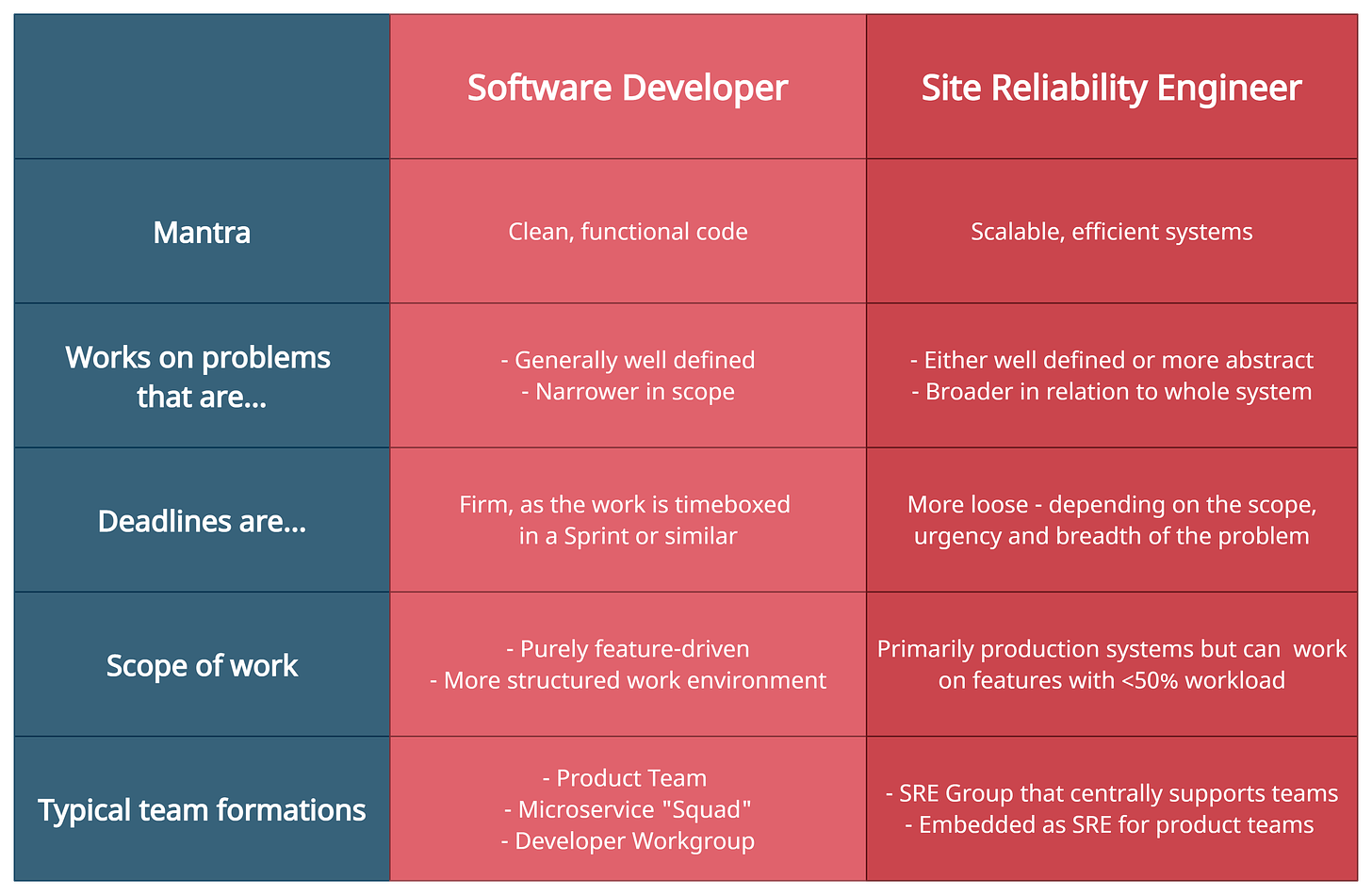
Both roles are chalk and cheese, so it’s worth considering key differences in how SREs work compared to software developers.
|
||
|
||
Chances are they will need to collaborate closely to make sure the software works well in production.
|
||
|
||
I took inspiration from a Google recruiter’s interview of an SRE, Ciara Kamahele ([link here](https://careers.google.com/stories/site-reliability-engineering-profile-google/)).
|
||
|
||
The key differences I uncovered are in table form below:
|
||
|
||
|
||
|
||
There you have it. SREs may be popularly known as software developers who happen to run systems, but they are quite unique in how they work.
|
||
|
||

|
||
|
||
[see all](https://www.srepath.com/author/kashaup/))
|